
An honest conversation about safety.
Is an underground dog fence safe for your dog?
If you’re asking whether an underground dog fence is safe, you deserve a straight answer instead of a slogan. This page covers how the correction works and why the training sequence matters more than the hardware. It also covers the situations where we’ll tell you this isn’t the right tool for your dog.

How the correction works
Tone first, then a correction we describe honestly.
1. A warning tone comes first
As your dog approaches the boundary, the receiver collar sounds an audible tone. With proper training, the tone alone does most of the work. A well-trained dog hears it and turns back long before anything else happens.
2. Then a brief static stimulation
If your dog continues past the warning zone, the collar delivers a brief static stimulation. We won't dress this up: it's an unpleasant, startling sensation. That's the point, because it interrupts. The level is adjustable, and we set it to the lowest setting your dog actually responds to. You're welcome to feel it on your own hand before your dog ever wears the collar.
3. The goal is a correction that becomes rare
When the training sequence is followed, most dogs learn the boundary quickly and encounters with the static correction become uncommon. A boundary that corrects your dog constantly was trained wrong, and that is the installer's fault, not the dog's.
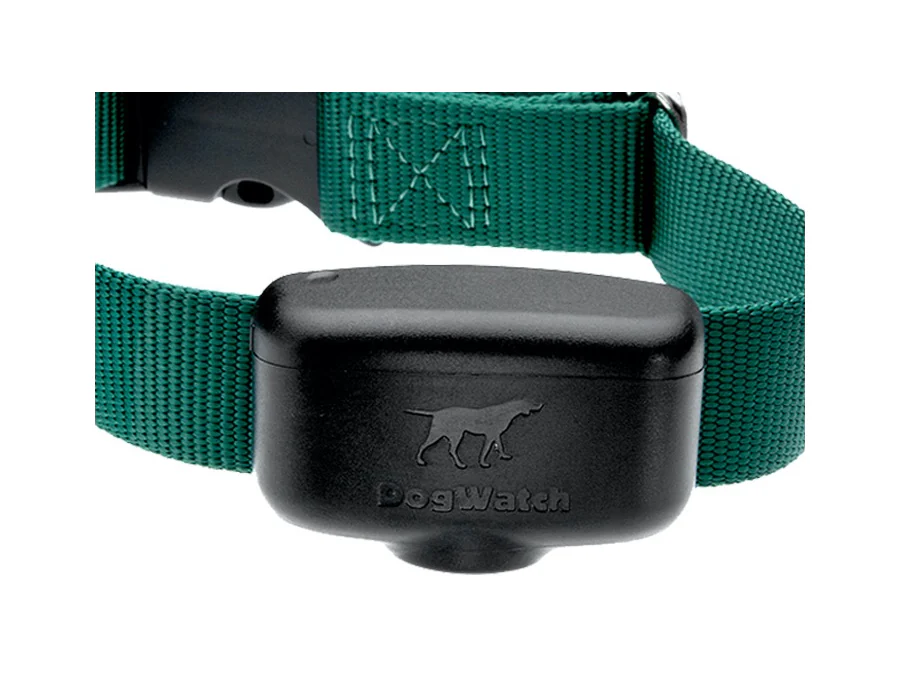
Every receiver we install has adjustable levels, and we set them per dog. A soft-tempered spaniel and a determined hound should never be on the same setting.
The real safety factor
Underground dog fence safety starts with the training sequence.
The equipment only delivers a signal. Whether that signal is fair, predictable, and low-stress for your dog comes down to how the boundary gets introduced. That is where professional installation matters.
Predictability is what keeps stress low
A dog who has learned the flags, the tone, and the turn-back knows exactly how to succeed. What creates anxiety is confusion: a correction that arrives without warning or context. That usually means a training phase got rushed or skipped.
The sequence is progressive on purpose
Flags and tone first, supervised boundary work second, distractions third, freedom last. Each stage exists so your dog is never guessing what the boundary wants.
Settings are per dog, revisited as needed
We start at the gentlest effective level, then adjust based on what your dog shows us. If something changes later, we set it again.
We don't hand you a box and leave
The first training session is part of every installation, you get all the training materials for the days that follow, and for a full year afterwards the person who ran that session comes back out to help with training at no charge.
Suitability, evaluated honestly
Most dogs do well. We still evaluate yours first.
Whether a boundary is right depends on your property and on your dog’s age, temperament, health, and history. Some dogs need an adjusted protocol. A few shouldn’t use one at all, and we say so.
Puppies
Training waits until a puppy is old enough to learn it fairly. For most dogs that means around 4 to 6 months, with basic commands in place. Starting too early teaches confusion instead of boundaries.
Anxious or fearful dogs
Some do well with a slower, tone-heavy protocol at the gentlest settings. For dogs with significant fear or anxiety, we may advise against a static-correction boundary entirely and tell you why.
Dogs with health conditions
For seniors and dogs with medical issues, we'll suggest a conversation with your veterinarian before you decide. If your vet says no, that settles it.
High-prey-drive dogs
Extended training and heavy distraction-proofing help most of them. For a small number of dogs, though, drive outruns any boundary. If we believe that's your dog, we'll tell you before you spend money.
Want to see how we’d think about your dog? Use the dog-by-dog evaluation on our homepage.
The other half of honesty
What an underground dog fence does not do.
A buried-wire boundary solves one problem: keeping your trained dog in the yard. Knowing what it doesn’t do is part of using it safely.
A determined dog can cross it
Training makes this uncommon, but no boundary is absolute. A dog in full chase can push through the correction. The part people don't expect is what happens next: the boundary works in both directions, so a dog who got out faces the same correction coming home and may stay out rather than cross again. If your dog is on the wrong side of the line, go to them and take the collar off before you walk back in together. Then tell us, and we'll work the training with you.
It doesn't keep anything out
Other dogs, wildlife, and people don't wear the collar. The boundary does nothing to stop them from entering your yard, so supervision still matters, especially if strays or wildlife are common where you live.
It's inactive during a power outage
No power, no boundary. While the power is out, treat your yard exactly like an unfenced yard: leash walks and supervision until it's restored. We'll explain backup options when we design your system.
A wire break pauses the boundary
If aeration, edging, or utility work cuts the buried wire, the transmitter alerts you and the boundary stops correcting until it's repaired. Treat the yard as unfenced until the break is fixed.
Suspect a wire break right now? The transmitter usually tells you with a beep or an indicator light. We locate breaks with specialized equipment and splice them with waterproof connectors, usually in a single visit, including on systems we didn’t install. See wire break repair.
Your part
A safe boundary is a partnership.
We design, install, and start the training. A handful of simple habits on your side keep the system working the way it was trained.
Check collar fit and skin regularly
The collar should be snug enough for contact but never tight. Make two things routine: taking it off for part of each day, and checking the skin under the contact points.
Keep a fresh battery in the receiver
A dead receiver is an open gate your dog can't see. The battery lasts about two years, which is exactly why it is easy to forget: nothing about your week reminds you. We'll tell you when yours went in, and a periodic battery check is worth making a habit.
Run the daily training sessions
Short, consistent practice is what turns the boundary into a habit. Skipping the daily work is the most common reason training stalls, and if it does stall, our one-year dog containment guarantee means we come back out and work on the training with you at no charge.
Treat outages and breaks as an unfenced yard
Power outage, wire-break alert, collar left on the counter: in all three cases the boundary is off. Leash up until it's back.
Tell us when something changes
A new dog, a move, a behavior change, a landscaping project near the wire: any of those is worth a quick call or text, so we can adjust before a small thing becomes an escape.
Suitability questions
What people ask us about whether it suits their dog.
Will the system work for my dog?
Most dogs do very well, but suitability depends on age, temperament, and your property, so we evaluate rather than promise. Puppies need to be old enough for training; anxious or high-prey-drive dogs need adjusted protocols. Tell us about your dog and we'll give you an honest read.
Weighing your options? See electronic vs. physical fencing or read how the system works.
Ask us whether it's right for your dog.
Send us your dog's age, temperament, and history. If a boundary isn't the right fit for them, we'll say so.